
Best Greyhound Betting Sites – Bet on Greyhounds in 2026
Loading...
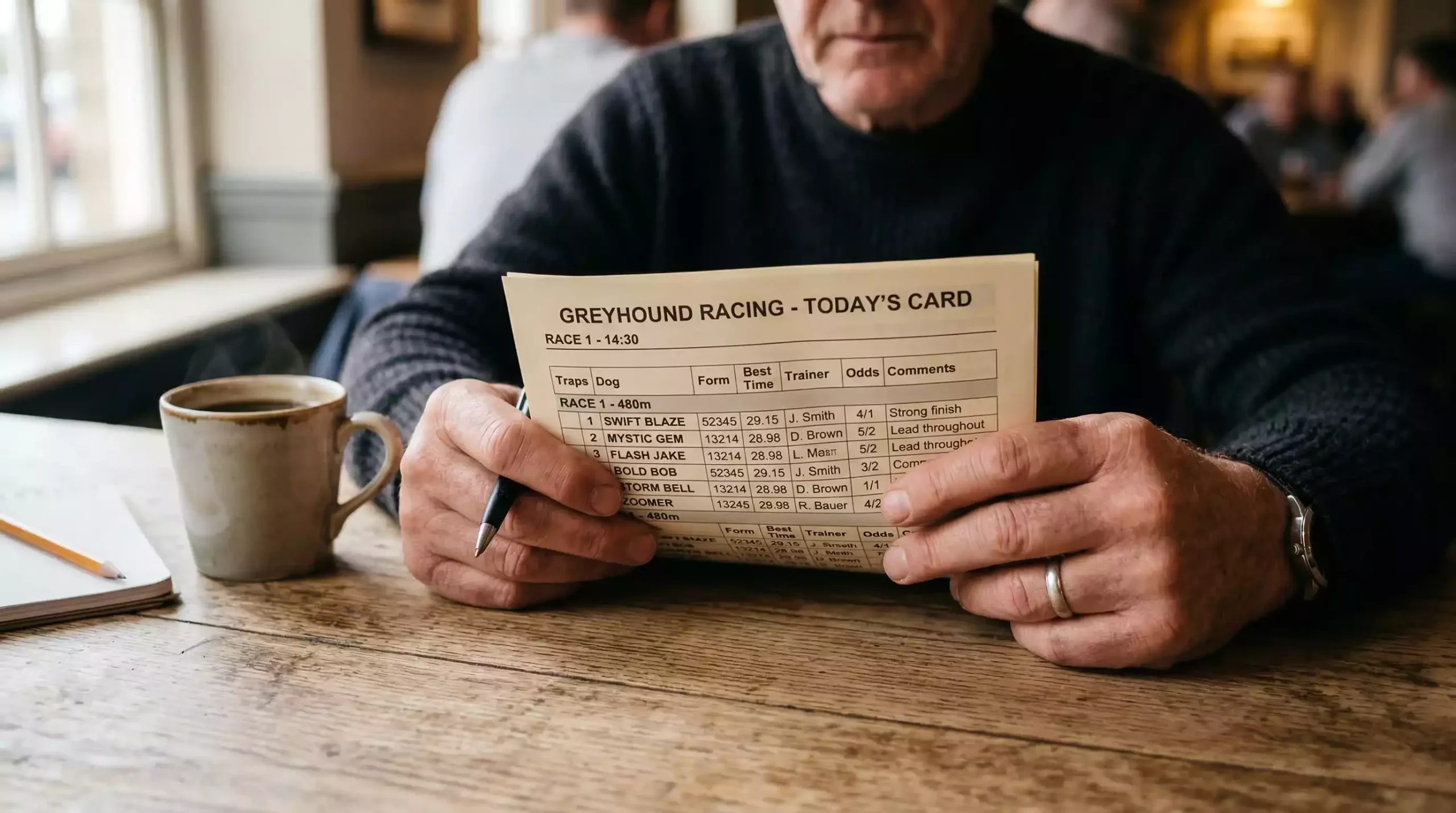
History predicts. Those two words summarise why form figures matter in greyhound racing. Every sequence of numbers displayed beside a dog’s name encodes its recent racing history, compressing complex performances into a string that practiced readers scan in seconds. Mastering this code separates casual punters from those who understand what they are betting on.
The British greyhound racing industry generates enormous volumes of data across its 21 licensed tracks. In 2024 alone, 355,682 individual runs were recorded on GBGB-licensed tracks, each producing finishing positions that flow into form records. Sheffield’s 260 annual meetings contribute substantially to this data stream, and every runner carries its history into each new race. Learning to read that history is the fundamental skill of greyhound form analysis.
What Form Figures Represent
Form figures display a greyhound’s finishing positions in reverse chronological order, with the most recent race appearing first. A sequence like 123456 means the dog won its last race, finished second before that, third before that, and so on through to sixth place six races ago. The numbers run left to right through time, the leftmost figure being yesterday’s news and the rightmost ancient history.
Six figures constitute the standard display, though some sources show fewer and some more. This six-race window captures approximately six weeks of racing for an active greyhound competing weekly, providing enough data to identify trends while remaining recent enough to reflect current form. Performances from months ago recede from view, replaced by fresher information as each new race adds a digit to the left and drops one from the right.
The figures 1 through 6 correspond to finishing positions in standard six-dog races. First place is victory, sixth place is last, and the positions between represent various degrees of defeat. However, raw position numbers tell only part of the story. A sixth-place finish could mean trailing by twenty lengths or being beaten by a neck after a troubled run; the figure alone does not distinguish between these drastically different performances.
This limitation is important. Form figures provide a shorthand for recent results but require supplementary information for meaningful interpretation. The time recorded, the trap drawn, the grade of race, and the circumstances of running all contribute to understanding what a finishing position actually reveals about a greyhound’s ability and current condition. Figures alone are a starting point, not a conclusion.
Reading Sequences and Patterns
Patterns within form sequences tell stories about a greyhound’s trajectory. Consider a sequence like 654321: a dog that finished sixth in its oldest recorded race and has improved with each subsequent outing, culminating in a win. This ascending pattern suggests a greyhound finding its form, perhaps returning from injury, settling into a new trainer’s methods, or simply maturing into full racing capability. The trend matters as much as the individual figures.
Conversely, 123456 presents a declining profile—recent races progressively worse than earlier ones. This descent could indicate injury, loss of form, inappropriate grading, or simple fatigue from over-racing. Without additional context, the pattern raises questions that demand investigation before backing the dog.
Consistency shows in repetitive sequences. A dog showing 333333 finishes third consistently, neither threatening to win nor collapsing to the rear. Such dogs may offer value in forecast or tricast betting, where consistent placing matters more than winning, but they rarely justify strong win support. Their predictability cuts both ways—you know roughly what to expect, but that expectation does not include frequent victories.
Erratic sequences like 162534 present interpretation challenges. These dogs show capability (the 1 and 2) but also vulnerability (the 5 and 6). Circumstances vary race to race—trap draws, competition quality, running luck—and this dog apparently responds strongly to those variables. Backing such greyhounds requires confidence that today’s conditions favour the upper end of their range.
At Sheffield, where track-specific factors influence results, patterns gain additional meaning. A dog showing improving form after trials at Owlerton may be adjusting to the track’s 425-metre circumference and Outside Swaffham hare. Sheffield specialists often display their best figures at this venue while showing weaker form elsewhere, a pattern that rewards those who track location alongside position.
Special Codes: F, M, T and Others
Not every race ends with a standard finishing position. Various codes substitute for position numbers when circumstances render normal classification impossible or inappropriate. Understanding these codes prevents misreading form sequences and reveals information that number-only analysis would miss.
The letter F indicates a fall. The greyhound went down during the race, failing to complete the course normally. Falls may result from crowding, clipping heels, losing balance on the bends, or simple misfortune. Whatever the cause, an F in the sequence raises questions about the dog’s recovery and confidence in subsequent races. Some greyhounds bounce back immediately; others carry the memory of a fall for several races, hesitating at crowding points where they previously ran freely.
M denotes that a greyhound was the subject of a stewards’ enquiry or an incident that led to reclassification. The specific circumstances vary, but the code alerts readers that this was not a straightforward race and the official result may obscure what actually happened on the track.
T indicates a trial rather than a competitive race. Greyhounds returning from layoffs or testing fitness after injury often trial before resuming racing, and these performances appear in form records with this distinguishing letter. Trial performance may or may not predict racing outcomes—the absence of competition changes the dynamic—but the T at least confirms the dog has been active.
Other codes exist for specific circumstances: disqualifications, void races, withdrawn entries. The standard racecard or form guide will explain abbreviations used by that particular publication. The key principle is recognising when a letter appears among the numbers and investigating what it signifies before drawing conclusions about the dog’s genuine form level.
Form as a Predictive Tool
Form figures provide one input into prediction, not the entire calculation. A greyhound’s recent finishing positions must be weighed against the circumstances of those races, the quality of opposition faced, the trap draws assigned, and the track conditions encountered. The numbers initiate analysis; they do not complete it.
The strongest predictive patterns combine recent form with appropriate context. A dog showing 111222 has been winning or placing consistently—but in what grade? At what tracks? Against which opponents? Those wins might have come against weak fields at lower grades, meaning little when the dog steps up in class. Alternatively, they might represent top-quality performances that the figures alone cannot fully convey.
Sheffield form carries particular predictive weight for Sheffield races. Dogs with strong recent figures at Owlerton have demonstrated their ability to handle this track’s specific demands: the 425-metre circumference, the Outside Swaffham hare, the run to the first bend. Away form provides useful information about general ability, but Sheffield form confirms compatibility with the track where they will actually race.
The trap draw interacts with form significantly. A greyhound showing poor recent figures from inside traps might be a wide runner continually drawn against its preferred racing line. The same dog, given an outside draw, could transform those fives and sixes into twos and ones. Reading form requires understanding context: part of good analysis involves understanding when dogs are being asked to perform in unsuitable conditions rather than simply labelling them as poor performers.
Ultimately, form figures serve as an efficient summary that enables rapid assessment before deeper analysis begins. The practiced eye scans sequences, identifies patterns, notes anomalies, and then investigates further. The figures do not predict; they inform the predictor.