
Best Greyhound Betting Sites – Bet on Greyhounds in 2026
 Available in US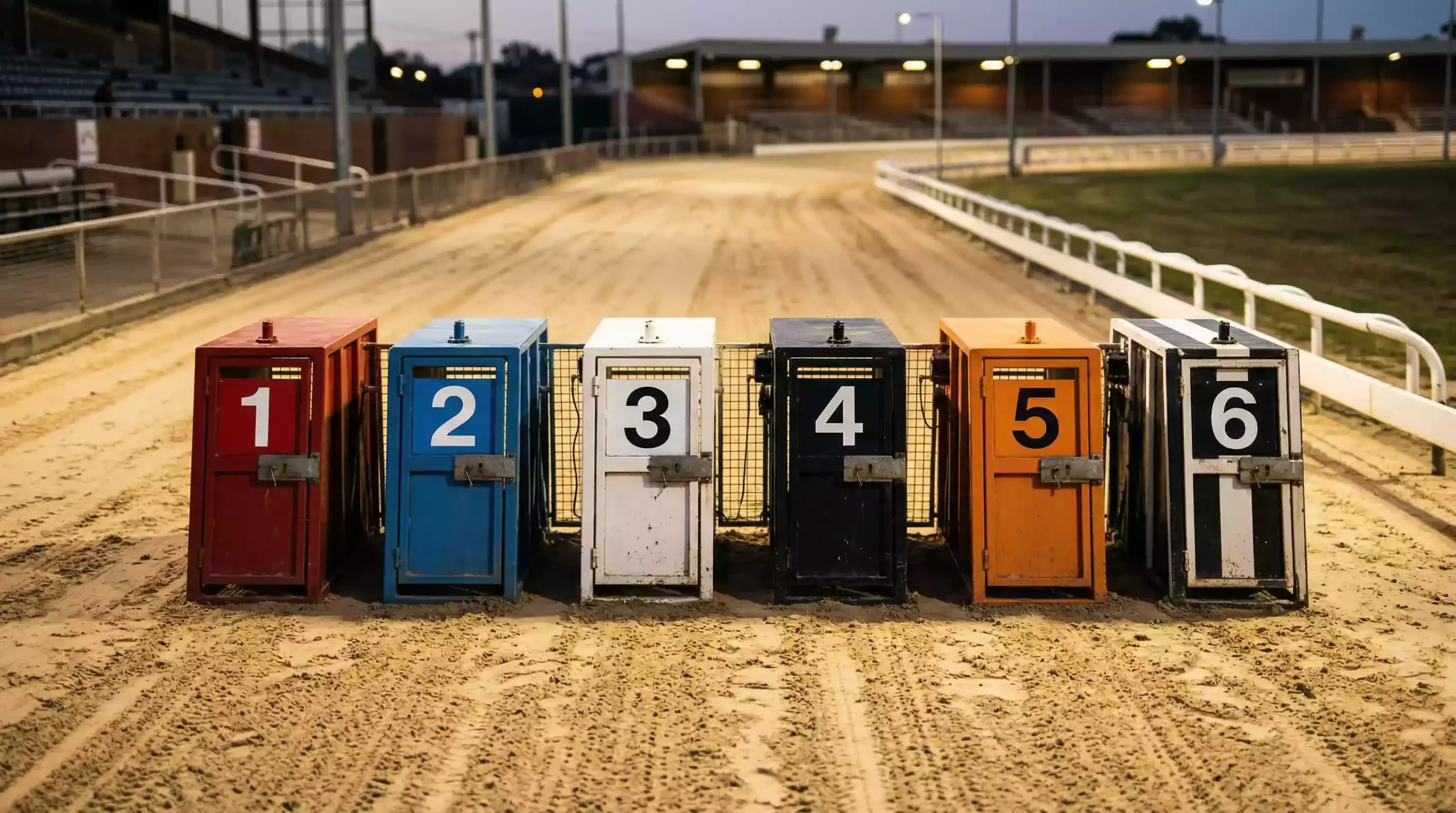
Geometry decides. Before a greyhound takes its first stride, the trap draw has already tilted the odds. Six dogs break from six boxes, but not all boxes are equal. The mathematics of track design—bend radii, run-up distances, racing lines—create systematic advantages that persist across thousands of races. Understanding trap bias transforms random observation into structured analysis.
Every track produces its own bias pattern. What holds true at Sheffield may reverse at Romford. The factors are physical and measurable: how far dogs travel before the first bend, how tight the turns, where the hare runs relative to the rail. These fixed elements combine with the variable behaviour of individual dogs to produce outcomes that appear random but follow predictable patterns. This is how trap bias works, and how to use it.
The Physics of Trap Bias
Greyhound racing unfolds on an oval track where dogs chase an artificial hare around a series of bends. The first bend matters most. Dogs arrive at speed, six abreast, competing for position on a narrowing racing line. Physics dictates that the inside line covers less distance than the outside. A dog on the rail travels the shortest path; a dog racing wide covers extra metres with every turn.
The run to the first bend determines how much this matters. At Sheffield Owlerton, dogs travel approximately 60.5 to 62 metres before reaching the first turn. This distance provides time for fast breakers to establish position but not enough for slower starters to recover. Dogs drawn inside—traps one and two—can take the shortest route if they break well. Dogs drawn wide—traps five and six—must either possess superior early pace or accept covering extra ground.
Track circumference amplifies or dampens these effects. Sheffield’s 425-metre circumference creates reasonably generous bends that allow wide runners to compete. Tighter tracks punish outside draws more severely because sharper turns magnify the distance differential. A dog losing a length per bend at Sheffield might lose two lengths per bend at a smaller venue. The same trap draw produces different outcomes depending on where you race.
The hare’s running line adds another variable. Sheffield uses an Outside Swaffham hare, which travels on the outside rail and pulls dogs toward the centre of the track on bends. This differs from inside-running hares that encourage dogs to hug the rail throughout. Outside hares can reduce inside trap advantage slightly because all dogs naturally pull toward the hare’s position rather than the geometrically shortest line.
Surface characteristics matter too. Sand tracks like Sheffield offer consistent grip, but moisture content affects how dogs corner. Wet conditions may favour dogs that handle the going while reducing the advantage of pure inside draws if all dogs struggle equally for traction. The physics remains constant; the conditions modify its expression.
Inside vs Outside Dynamics
Inside traps carry theoretical advantage, but racing rarely matches theory. A slow-breaking trap one runner yields the rail to a faster trap two or trap three dog, gaining nothing from its draw. The advantage belongs to whichever dog secures the inside line first, not necessarily the dog drawn closest to it.
Trap one demands early pace to convert position into advantage. A dog that breaks level or behind from the red box finds itself trapped against the rail with nowhere to go, watching wider-drawn rivals move past on the outside. For front-runners with genuine gate speed, trap one is ideal. For dogs that need time to find their stride, it can become a prison.
Trap six presents mirror-image challenges. The wide draw requires covering extra ground immediately, but it offers racing room. A strong-breaking trap six runner can cross toward the rail before the first bend, converting early pace into position. Dogs that habitually run wide—whether by preference or necessity—often perform better from outside draws where their natural path creates no interference.
Middle traps—three and four—frequently show the strongest overall statistics. These boxes avoid both extremes: dogs need not possess explosive pace to escape the rail, nor must they overcome geometric disadvantage from the widest draws. The middle path offers options. A dog breaking well can move inside; one breaking slowly can angle out. This flexibility suits a wider range of running styles.
Running style interacts with trap draw constantly. A confirmed railer drawn in trap five faces a problem: reaching the rail requires either extreme early pace or luck with rivals’ positioning. A wide runner drawn in trap one must either break poorly or fight against natural instinct to avoid the rail. Matching running style to trap draw separates astute punters from those who ignore the connection.
How Different Tracks Vary
No universal trap bias applies across all venues. Each track’s geometry creates unique patterns that serious punters must learn individually. Sheffield’s characteristics differ from Nottingham’s, which differ from Perry Barr’s. Assuming one track’s bias applies elsewhere produces systematic errors.
Track circumference provides the primary distinction. Larger tracks with wider bends reduce inside advantage because the distance differential per turn diminishes. Sheffield’s 425-metre circumference sits in the middle range for UK tracks. Smaller tracks like Romford (360 metres) show more pronounced inside bias. Larger tracks would show less, though few truly large circuits remain in operation.
Run-up distances vary significantly between venues. Sheffield’s 60.5-62 metre run gives dogs reasonable time to sort positions before the first bend. Shorter runs intensify early speed requirements and amplify the value of inside draws. Longer runs allow wider-drawn dogs more opportunity to cross toward the rail, reducing trap bias effects.
Different distances at the same track can show different bias patterns. Sheffield’s sprint races over 280 metres involve fewer bends than staying trips over 900 metres or more. Inside advantage compounds with each turn—a small edge per bend becomes substantial over four or five bends in longer races. Sprints may show weaker trap bias simply because fewer bends occur.
Historical data reveals track-specific patterns more reliably than theoretical analysis. Services tracking thousands of results across years provide statistical evidence of which traps outperform expectation at specific venues. At Sheffield, this data guides serious punters far more effectively than assumptions about how bias should work. The track tells you its tendencies if you listen to the numbers.
Using Bias in Selections
Applying trap bias requires balancing statistical tendencies against individual form. A trap with 18% win rate versus another with 14% suggests advantage, but a superior dog drawn badly remains the better selection. Bias tilts probabilities; it does not determine outcomes.
The most productive use of trap bias involves competitive races where form offers little separation. When three or four dogs hold comparable claims, trap draw becomes the deciding factor. The dog matching running style to starting position—a railer from trap one, a wide runner from trap six—gains edge over rivals in less suitable draws.
Pace analysis combines with trap assessment. A race featuring two confirmed front-runners drawn in traps one and two will see them contesting the early lead, potentially compromising both. A strong finisher drawn wide may benefit from this battle, picking up the pieces while rivals tire. Reading how trap draws will affect racing dynamics matters more than raw trap statistics alone.
Betting markets sometimes ignore trap bias, creating value opportunities. A dog dropping from trap one where it won easily to trap six in its next race may retain short odds based on that victory, even though the wide draw significantly reduces its chances of repeating. Spotting these mismatches—where market prices ignore geometric reality—represents one of the more reliable edges available to students of the form.
Finally, track conditions modify bias effects. Going soft after rain may reduce inside advantage if all dogs struggle for grip equally. Fast going may amplify it by allowing quick breakers to convert early position more decisively. Adjusting bias expectations for prevailing conditions adds another layer to selection methodology, separating basic awareness from sophisticated application.
Trap Draw Bias — More on this topic at sheffield dogs results.
See also Greyhound Racecard Abbreviations.
