
Best Greyhound Betting Sites – Bet on Greyhounds in 2026
Loading...
Learning how to read Sheffield greyhound racecard information transforms casual betting into informed analysis. The racecard contains everything you need to evaluate a race before wagering a penny, but only if you know what each element means and how to interpret the data together. Most punters glance at form figures and pick a number; successful punters decode the data systematically.
Sheffield Owlerton presents racecards following the same conventions as other British tracks, though the specific conditions at Owlerton, including its 425-metre circumference and nine available race distances, influence how you should interpret certain metrics. A time that looks impressive at one track might prove average here, and a racecard remark that means trouble elsewhere could indicate opportunity at Sheffield.
The data available to punters has improved significantly as the sport has embraced transparency. According to GBGB injury and retirement data, the regulatory body now publishes detailed statistics that help contextualise individual performances against industry-wide patterns. This commitment to data accessibility extends to racecard information, where standardised formats ensure punters can compare dogs fairly across different tracks and time periods.
This guide walks through every element of a Sheffield racecard in detail. You will learn what form figures actually represent beyond simple finishing positions, how to extract predictions from split times, what the abbreviated remarks tell you about racing incidents, and how to synthesise all this information into sound betting decisions. Whether you are new to greyhound racing or looking to sharpen existing skills, mastering the racecard is where improvement begins.
Anatomy of a Sheffield Racecard
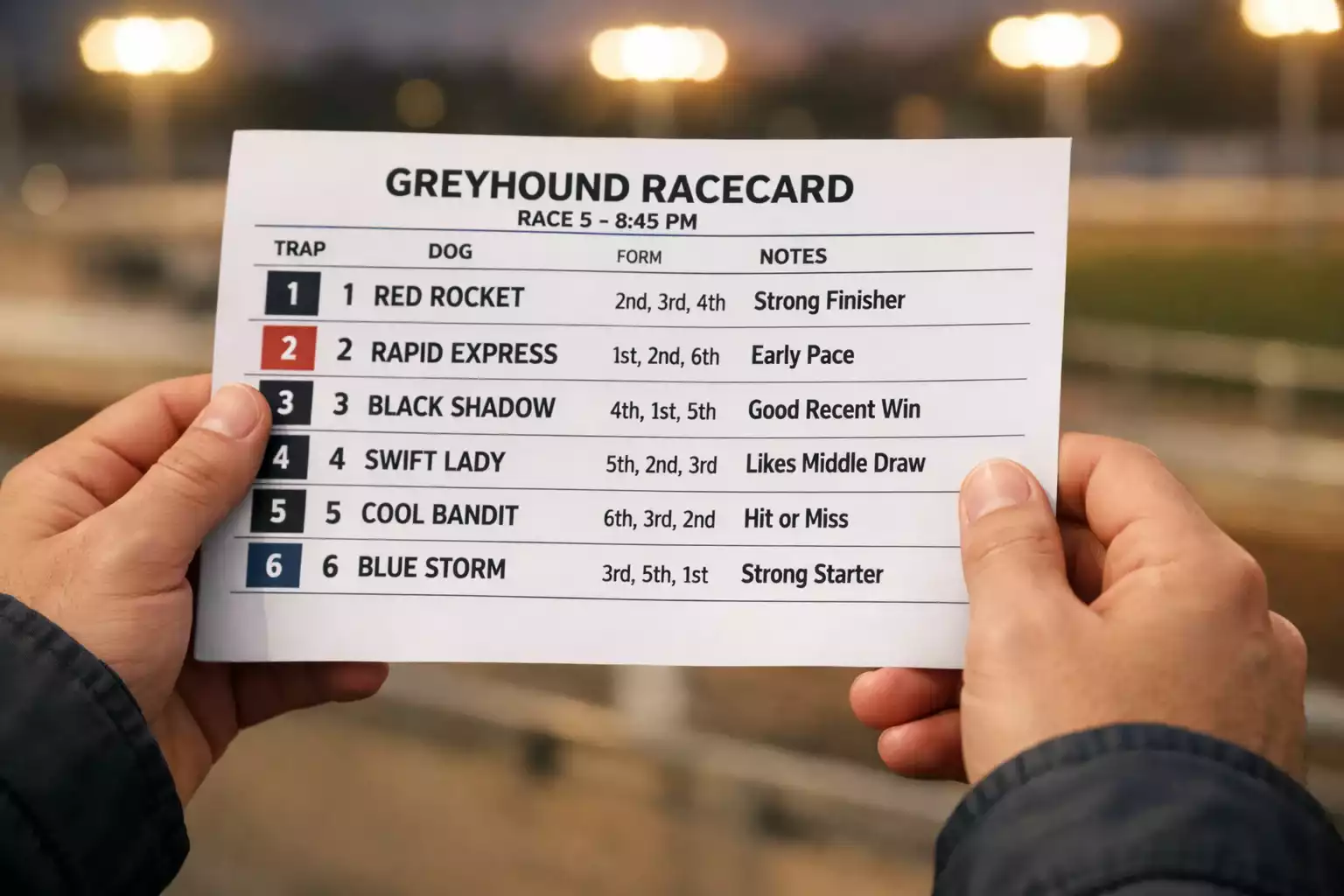
A Sheffield racecard presents information in a standardised format that packs considerable data into limited space. Understanding the layout saves time during analysis and prevents the confusion that leads to missed opportunities or careless mistakes.
Each dog’s entry begins with the trap number and its corresponding colour. Trap one wears red, trap two blue, trap three white, trap four black, trap five orange, and trap six displays black and white stripes. The dog’s racing name appears next, sometimes shortened in print but always sufficient for identification. The trainer’s name follows, providing your first clue about the greyhound’s preparation and recent form trajectory.
The form figures occupy a prominent position, typically showing the last six race results reading left to right from oldest to most recent. These single digits (1 through 6) represent finishing positions, though letters sometimes appear for special circumstances that the form figures section below explains in detail.
Time information appears in multiple formats. The best recent time at the race distance gives a quick indicator of ability, while sectional times or split data reveal how the dog typically runs through the race. Sheffield’s standard distances of 480 metres and 500 metres dominate the schedule, so most form will relate to these trips.
Weight appears in kilograms and provides insight into the dog’s current condition. Experienced punters compare today’s weight against previous appearances to detect significant changes. Age shows as a number of years and months, helping identify dogs at different career stages.
The remarks column contains abbreviated codes describing incidents from previous races. These shorthand notations reveal whether a dog suffered interference, led the field, or experienced problems that affected its finishing position. Learning to read remarks quickly transforms your understanding of what form figures actually mean.
The grade or class designation indicates the quality of competition. Sheffield operates multiple grades from novice races through open competitions, and knowing the grade helps contextualise times and form figures against appropriate benchmarks.
Decoding Form Figures
Form figures condense recent racing history into a sequence of numbers that experienced punters read at a glance. A dog showing 111111 has won its last six races. One displaying 654432 is improving. The sequence 123456 indicates declining form. Learning to read these patterns quickly distinguishes serious analysts from casual punters who treat form figures as lottery numbers.
The most recent run appears on the right side of the sequence, making recency obvious when scanning entries. A form line reading 432211 shows a dog that struggled in older races but has found winning form recently, exactly the opposite impression you might get reading left to right. Always orient yourself properly before drawing conclusions.
Numbers alone tell part of the story. A fifth-place finish could mean the dog ran poorly or could mean it encountered interference that cost positions. This ambiguity is precisely why the remarks column exists, and why smart punters cross-reference form figures with remarks before making judgments.
Letter codes interrupt numerical sequences to indicate specific circumstances. F means the dog fell during the race, an unusual but significant event that might indicate either bad luck or physical problems. M signifies a wide margin of victory, suggesting the winning performance was particularly dominant. T indicates a trial run rather than a competitive race, which should be weighted differently during analysis.
Form at the specific distance matters more than aggregate form. A dog showing excellent figures over 280 metres might struggle when stepped up to 660 metres, and the form figures do not always distinguish between trips. Check whether recent runs occurred at the same distance as today’s race before assuming the numbers carry across.
Track-specific form deserves special attention. Sheffield’s 425-metre circumference and unique first-bend geometry create conditions that differ from other venues. A dog with patchy overall form but consistent Sheffield results might represent value that punters focused solely on aggregate figures miss. Always note which track produced each form figure when that information appears on the racecard.
The frequency of racing affects how you should weight form figures. Dogs racing twice weekly produce fresher form than those appearing monthly. Sheffield’s busy racing calendar means most regular competitors show recent Sheffield form rather than form gathered at distant tracks weeks ago. This recency makes Sheffield form figures particularly reliable because they represent current ability rather than historical snapshots.
Consistency patterns tell their own story. A form line of 333333 looks unimpressive until you notice the dog finishes third in every race against different opponents. This consistency suggests the greyhound knows exactly what it is doing but lacks the raw ability to beat quality opposition. Such dogs might represent each-way value but rarely win outright. The punter who recognises consistency patterns avoids both overvaluing and undervaluing reliable performers.
Split Times and Sectionals
Split times break a race into segments, revealing how dogs perform through different phases rather than just at the finish line. At Sheffield, the run to the first bend spans between 60.5 and 62 metres depending on starting trap position, and the sectional time for this segment often predicts finishing positions more accurately than overall times do.
The first sectional measures early pace, the critical quality that determines who leads into the first bend. A dog consistently posting fast first-bend times will typically hold or contest the lead regardless of trap draw, while slow sectional times indicate a runner that needs clear running to finish strongly. When analysing a Sheffield racecard, fast first-bend sectionals combined with an inside trap draw create the classic winning profile.
Later sectional times reveal finishing ability. Some dogs run even splits throughout, maintaining similar pace from start to finish. Others fade in the closing stages after blazing early, while late runners produce their best sectional times in the final segment. Matching these patterns to race conditions helps identify which dogs suit the day’s specific contest.
Comparing sectional times across dogs requires care because trap position affects the distance covered during early sections. A dog from trap six has further to run to reach the first bend than one from trap one, so slightly slower first-bend times from outside draws might not indicate inferior early pace. Adjust your expectations based on starting position before concluding that one dog holds a sectional advantage.
Sheffield’s track records at each distance provide context for sectional interpretation. Knowing the fastest times ever recorded over 480 metres or 660 metres helps calibrate whether a dog’s sectional splits represent genuinely quick running or merely average performance. Track records change infrequently, so the benchmarks remain stable reference points.
Sectional data does not appear on every racecard in complete detail. When full splits are unavailable, the best time figure and remarks provide partial substitutes, though with less precision than true sectional analysis allows. Some punters supplement racecard information with data from specialised services that track sectionals across all British racing.
Remarks and Abbreviations
The remarks column uses standardised abbreviations to describe racing incidents without consuming excessive space. Learning these codes transforms form figures from ambiguous numbers into a coherent narrative of each dog’s recent performances. A disappointing fourth place looks very different when the remarks reveal it involved being crowded at the first bend versus fading through lack of fitness.
Movement abbreviations describe how the dog ran its race. Led indicates the dog led at some point, though not necessarily throughout. Rls means the dog raced along the rails, the inside line that represents the shortest route. Wide indicates running away from the rails, covering extra ground but potentially finding cleaner air. These positional descriptions help identify running styles that suit specific trap draws.
Interference abbreviations document trouble during the race. Crd stands for crowded, meaning the dog found itself sandwiched between rivals without room to run freely. Bmp indicates bumping with another dog, a collision that disrupted stride pattern. Ck means checked, signifying that the dog had to slow or alter course to avoid trouble. Each interference notation suggests the finishing position underrepresents the dog’s true ability that day.
Starting abbreviations describe the break from the traps. SAw means slow away, indicating the dog lost ground at the start, potentially through hesitation, trap trouble, or slow reflexes. QAw means quick away, the opposite problem that sometimes becomes an advantage. VSAw indicates very slow away, a severe starting issue that typically ruins any realistic winning chance regardless of other qualities.
Falling and injury remarks require careful interpretation. F indicates a fall during the race, while Fell shows the same in spelled-out form. Falls sometimes occur due to interference from other dogs, making them bad luck rather than physical problems. Other falls suggest coordination issues or injuries that might recur. Checking subsequent races helps distinguish between isolated incidents and concerning patterns.
Combination remarks describe multiple events. A dog showing CrdBmp2nd encountered both crowding and bumping before finishing second, explaining a result that might otherwise look worse than the underlying performance deserved. Reading multiple abbreviations together builds a complete picture of each race’s dynamics.
Run pattern abbreviations help predict future behaviour. EvCh indicates the dog ran evenly throughout, maintaining similar pace from start to finish. RanOn means the dog finished strongly, suggesting late pace that benefits from clear running. FinWl indicates finishing well despite other circumstances. These patterns help identify dogs suited to different race types and trap draws at Sheffield’s various distances.
Learning to speed-read remarks transforms your pre-race analysis. Instead of puzzling over abbreviations, you will scan entries and immediately understand why each dog finished where it did. That understanding enables faster, more accurate assessments when time pressure mounts before race starts. The racecard tells a complete story if you speak its language.
Times: Actual vs Calculated
Greyhound racing uses two distinct time measurements that serve different analytical purposes. Actual time records exactly how long the dog took to complete the race, measured from trap opening to crossing the finish line. Calculated time adjusts the actual time based on track conditions, creating a standardised figure that allows fair comparison across different racing days.
Track conditions affect running times significantly. A fast track on a dry summer evening might produce times two or three tenths of a second quicker than a heavy winter surface. Without adjustment, comparing form across seasons becomes unreliable because identical performances would show different times. The going allowance system addresses this problem.
Going allowance represents the adjustment applied to actual times to produce calculated times. Track officials assess conditions before racing and assign a going figure expressed in tenths of a second. A going of -20 indicates a fast track where dogs run two tenths quicker than standard. A going of +30 suggests heavy conditions where dogs run three tenths slower. The calculated time adds or subtracts this allowance to normalise performances.
Calculated times enable meaningful comparison between races run under different conditions. A dog recording 28.50 actual time on +20 going produces a calculated time of 28.30, representing equivalent performance to another dog that recorded 28.30 actual time on level going. This standardisation is essential for form analysis at Sheffield, where conditions vary substantially across the season.
Best times on racecards typically show calculated figures rather than actual times, though formats vary between publications. Understanding which measurement you are viewing prevents analytical errors. A dog whose best time looks slow might actually have performed well on heavy going, with the actual time slower than the calculated time suggests.
Sheffield’s track record of 27.27 seconds at 480 metres, set by Roxholme Magic in September 2020, represents an actual time recorded under specific conditions that day. Comparing everyday performances against track records requires awareness that records typically occur on fast going and might overstate how far typical dogs fall short of elite ability.
Understanding times across Sheffield’s full range of nine racing distances helps calibrate expectations. The 280-metre sprint record stands at 15.65 seconds, while the 934-metre marathon record shows 56.28 seconds. These benchmarks were all set under varying conditions, so calculated time comparisons within each distance provide more useful guidance than raw times measured against records. The 480-metre and 500-metre distances dominate Sheffield’s racing schedule, making familiarity with competitive time standards at these trips particularly valuable for regular punters.
Weight, Age, and Sex
Physical data on racecards provides clues about current condition and career stage that form figures alone cannot reveal. Weight changes between races might indicate improving fitness or concerning weight loss. Age affects how much improvement remains possible. Sex influences racing style and competitive characteristics. Together, these factors help predict future performance beyond simple form extrapolation.
Weight appears in kilograms and fluctuates between racing appearances. A greyhound weighing 32kg in its previous race might appear at 31.5kg today, suggesting the trainer has made deliberate conditioning changes. Weight losses of half a kilogram or more often indicate fitness work aimed at sharpening a dog for a particular race. Significant gains might suggest recovery from injury or simply weight gain that could slow performance.
Interpreting weight changes requires context. Some dogs race better at specific weights, with trainers targeting their optimal racing condition. Others show consistent weights because their metabolism naturally stabilises. Dramatic weight changes in either direction often signal something unusual about the dog’s preparation or health.
Age affects both current ability and improvement potential. Greyhounds typically reach peak racing ability between two and four years old, with most competitive careers ending before age six. A two-year-old showing improving form might have substantial further progress ahead, while a four-year-old displaying similar improvement has likely reached or passed its ceiling.
Experienced dogs carry the advantage of proven form but the disadvantage of limited upside. Younger dogs might outperform their current form as they mature, but they also carry more uncertainty because they have established less track record. Balancing these factors depends on your betting approach and risk tolerance.
Sex differences influence racing behaviour in ways that affect betting analysis. Dogs (males) typically race against other dogs, while bitches (females) compete separately in most grades. Mixed-sex racing occurs in some open races, where physical differences can create advantages. Dogs generally weigh more and show more aggressive racing style, though individual variation exceeds average sex differences.
Putting It Together: Analysis Example
Theory becomes useful only through application. Consider a hypothetical Sheffield 480-metre race where you must evaluate a dog showing the following racecard data: trap three (white), form 432211, best time 27.85 calculated, weight 30.5kg (previously 31kg), age three years seven months, remarks from recent races including Led, Crd2nd, CkBmp3rd, Led1st, Led1st.
The form figures show clear improvement. Starting with a fourth, the dog has finished progressively better in each subsequent race, winning the last two outings. This ascending trajectory suggests either returning fitness after a problem or genuine ongoing improvement, likely given the three-year-seven-month age that places the dog in prime racing years.
The best calculated time of 27.85 for 480 metres compares favourably against Sheffield’s track record of 27.27, sitting roughly six tenths off the absolute best while representing solid ability for graded racing. Context matters here: how does 27.85 compare against today’s opponents? If others show best times around 28.20, this dog holds a clear time advantage.
Weight has dropped half a kilogram, from 31kg to 30.5kg, suggesting deliberate conditioning work by the trainer. Combined with the improving form and recent victories, this weight change indicates the dog is being pointed toward peak performance. The timing suggests the trainer sees opportunity in the current race.
The remarks reveal the running style and recent racing fortune. Led appears frequently, indicating this dog shows early pace and typically contests or holds the lead. Crd2nd and CkBmp3rd show that two of the non-winning runs involved interference, meaning the fourth and third-place finishes underrepresent actual ability. The dog deserved better results that day.
Trap three in white sits in the middle of the track, neither favouring nor penalising the early pace this dog shows. Combined with the Leading remarks, expect this runner to challenge for the first bend and either hold position or settle just behind depending on what breaks from traps one and two. The trap draw is neutral rather than advantageous but certainly not problematic.
The complete picture shows an improving young dog with proven early pace, a trainer making conditioning adjustments that suggest confidence, form figures partly distorted by interference, and a neutral trap draw. Against appropriate opposition, this profile makes the dog a genuine contender worth serious consideration. Whether the betting market has already recognised these factors determines whether value exists at the offered odds.
This systematic approach applies to every race you analyse. Start with form figures for the overall trajectory, add remarks for the detailed story, incorporate times for ability assessment, note physical data for condition clues, and evaluate the trap draw against running style. The racecard contains the information; your job is extracting meaning from that data consistently. As Mark Bird, CEO of the Greyhound Board of Great Britain, has observed regarding the sport’s regulated environment: “We have the data to prove our welfare standards are strong.” That same data-driven approach separates successful punters from those relying on hunches and lucky numbers.